On this page
What a total hip replacement involves
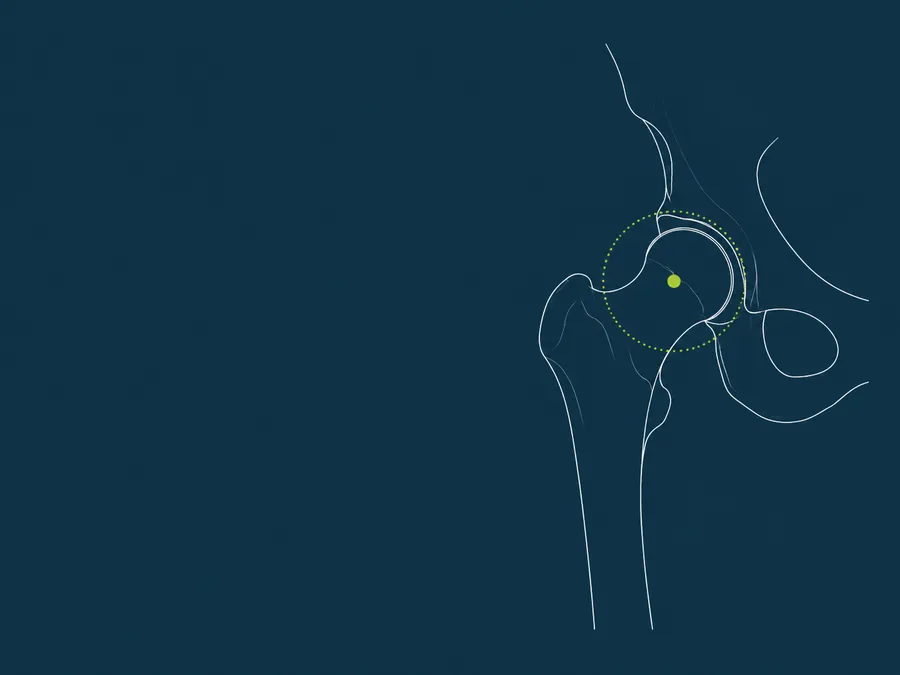
The damaged femoral head is removed and replaced with a stem seated in the thigh bone topped by a ball; the socket is resurfaced with a cup and a liner. The combination of ball and liner materials — the bearing surface — is one of the two decisions that shapes long-term performance. The other is fixation: cemented, cementless, or hybrid.
Ask which bearing surface is planned and why. Ceramic-on-highly-cross-linked-polyethylene and metal-on-highly-cross-linked-polyethylene are the common contemporary combinations. If anyone proposes a metal-on-metal bearing, ask a lot of follow-up questions.
Direct anterior versus posterior: what actually changes
The direct anterior approach reaches the joint between muscle planes rather than detaching muscle. Patients often mobilize faster in the first weeks and hip precautions are usually less restrictive. It is more technically demanding, more sensitive to body habitus, and carries its own specific risk of lateral femoral cutaneous nerve irritation.
The posterior approach is the long-established workhorse: excellent exposure, versatile for complex anatomy, well-understood outcomes. It typically comes with posterior hip precautions for a defined period — limits on flexion, adduction and internal rotation.
The right answer is the approach your surgeon does routinely and does well. A surgeon's volume with a given approach matters more than the approach itself. Ask how many they do a year.
Cost and what the package should include
Typical 2026 U.S. self-pay pricing runs roughly $40,000 to $60,000. Typical Colombian all-inclusive package pricing runs roughly $11,000 to $13,000. Market ranges, not quotes.
The package should name the implant system, the bearing surface, the fixation method, the number of inpatient nights, and the physiotherapy block. Exclusions to ask about specifically: extra nights, treatment of complications, imaging done outside the facility, and any assistive equipment you'll need.
Time in country and daily logistics
Plan on 18 to 21 days, with two to four inpatient nights and mobilization starting the day after surgery. Hip patients typically get moving sooner than knee patients, but the fly-home clearance still comes from the surgeon.
Practical requirements for your accommodation: elevator access, no interior stairs, a raised toilet seat if you're on posterior precautions, a chair with arms at the right height, and flat streets outside the door. Ask your coordinator to confirm these in writing before you pay for lodging.
Risks specific to hip arthroplasty
Dislocation, leg length discrepancy, periprosthetic fracture, infection, venous thromboembolism, nerve injury, and loosening or wear over time. Dislocation risk is highest in the first weeks, which is exactly the period when you'll be travelling and adjusting to unfamiliar accommodation — a good reason to take the precautions instruction seriously and to build the trip around a low-risk environment rather than around sightseeing.
Common questions
Is the anterior approach worth seeking out?
It has real advantages in the early weeks and less restrictive precautions for many patients, but the strongest predictor of a good outcome is surgeon volume with whichever approach is used. A high-volume posterior surgeon will generally serve you better than a low-volume anterior one. Ask how many hips they do a year and how many by that approach.
How soon can I fly home after a hip replacement?
Commonly around two to three weeks, set by the surgeon rather than your ticket. Long-haul flying in the early post-operative window raises clotting risk, so expect specific instructions on anticoagulation, compression, seat selection and moving regularly during the flight.
Will I need a walker or crutches, and can I take them on the plane?
Almost certainly yes for a period, and airlines accommodate mobility aids as standard. Arrange wheelchair assistance at every airport in your itinerary when you book — including connections. It's free, and it removes the single most exhausting part of the journey home.
Can hip resurfacing be done instead?
Resurfacing suits a narrow patient profile and is offered less widely than total replacement. Whether you're a candidate depends on your bone quality, anatomy, age and activity goals, and it's a surgeon-level decision made on your imaging — not something to decide from a website.
What about both hips?
Bilateral hip replacement on one trip is done, but it removes your ability to offload onto the other side during early recovery. If it's being considered, plan for a companion and supervised accommodation, and expect a longer stay.